


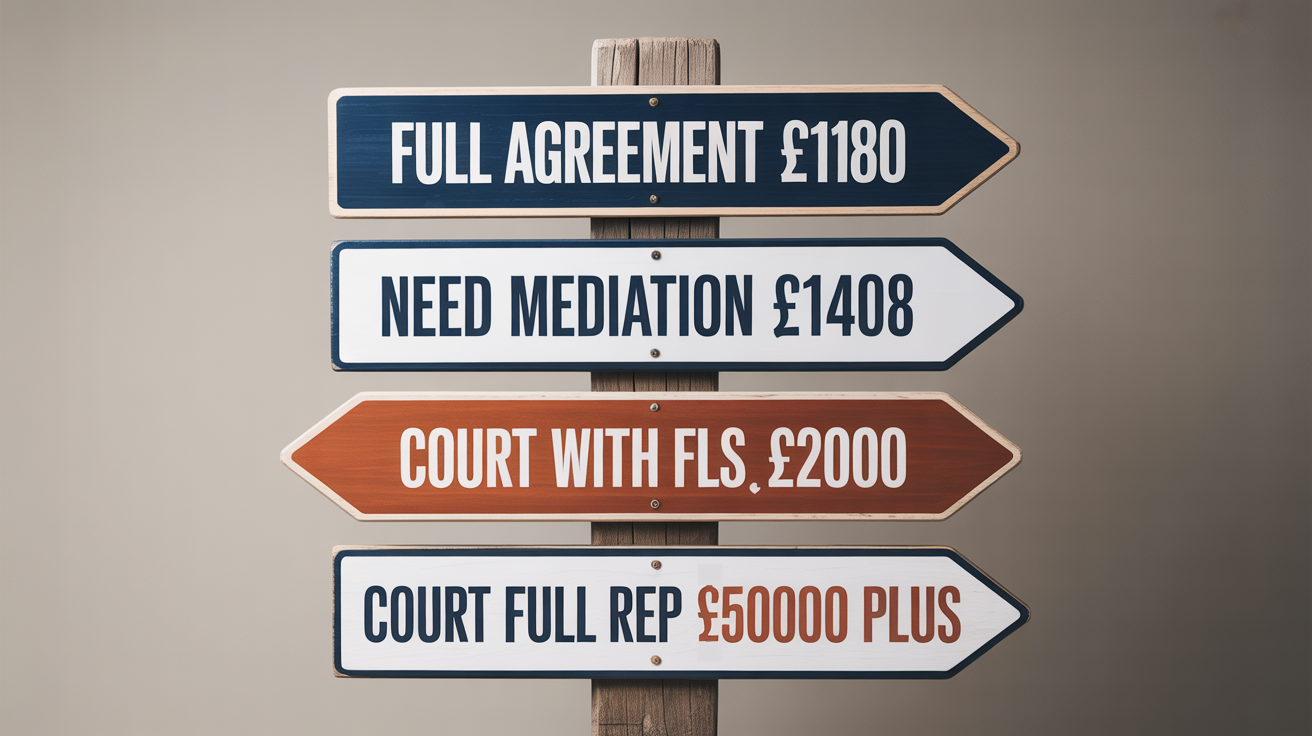
Cost of Legal Help for Divorce and Family Issues
Updated 15 December 2025 | Fact Checked By Jess Knauf, Co-Founder, Family Law Service
Summary
- Affordable divorce and family law help depends on how much you can agree with your ex. Agreement can save tens of thousands in court costs
- The divorce itself costs £612 and most people handle it themselves, it’s agreeing the finances and child arrangements that can get expensive
- Legal aid for mediation is available on low incomes, helping couples reach agreement without court battles costing £15,000 to £50,000+
- FLS AI Barrister Review (£9.50) shows what a court would likely order, helping you reach realistic agreements before positions harden
- If you can’t avoid court, fixed-fee services provide court form help and court preparation from £299, versus £25,000+ for full representation
- Court fee exemptions can eliminate the £612 divorce fee and other court costs for eligible applicants
- There is a government funded £500 voucher towards mediation for child arrangements
Affordable divorce and family law help feels impossible to find when you’re already stressed about ending your relationship. You’ve probably seen solicitor quotes of £15,000, £25,000, or more, and wondered how anyone affords it.
Here’s the reality: the more you agree with your ex, the less your divorce costs. It’s really that simple.
Filing for divorce costs £612. Most people do this themselves online, it’s straightforward paperwork. But agreeing how to split your house, pensions, and savings? Deciding where the children live and how much time they spend with each parent? That’s where costs can spiral into five figures if you end up fighting in court.
This guide shows you how to reach agreements (even difficult ones) without burning through your savings, and what help exists when you’re stuck.
The One Truth About Keeping Divorce Costs Low
It is the disagreement between you and your ex that costs the most, not the divorce itself.
If you and your ex can agree on finances and children, your total divorce costs might be under £700. If you fight every issue through court with solicitors representing you both, you’re looking at £40,000 to £75,000 each and sometimes more.
Most couples fall somewhere in between. You agree on some things, disagree on others. The skill is knowing when to compromise, when to stand firm, and when you actually need a court to decide. Deciding where to spend the money together, if you cannot agree on an issue, is empowering and saves you both money.
“At Family Law Service, we often see clients who think they need to fight for everything,” says Jess Knauf, Co-Founder. “But when they use our AI Barrister Review for £9.50 and see what a court might actually order, they realise their position isn’t as strong as they thought. Or their ex’s position isn’t as strong as feared. That report becomes the basis for a sensible conversation, not a £30,000 court battle.”
Do You Actually Qualify for Legal Aid?
In England and Wales, legal aid for divorce itself was scrapped in 2013. That means the state won’t pay for a solicitor to handle your divorce paperwork or court applications, with three important exceptions:
- Domestic abuse cases (including financial abuse)
- Child abduction situations
- Risk of homelessness
If you’ve experienced abuse, you’ll need evidence, such as a police report, a domestic violence protection notice, or a letter from a professional like your GP or a domestic abuse support worker. Check the full list of accepted evidence on GOV.UK.
What About Legal Aid for Mediation?
This is where things get more hopeful. Legal aid for family mediation is still available if you’re on a low income or benefits.
Here’s what it covers:
- Your initial mediation assessment meeting (called a MIAM)
- Follow-up mediation sessions until you reach an agreement
- The memorandum of understanding document
- A solicitor reviewing that document and making it legally binding
- Your ex-partner’s MIAM and their first joint session, even if they don’t qualify themselves
Your mediator applies for the legal aid on your behalf. If approved, the government pays them directly. Find accredited mediators through the Family Mediation Council.
The income threshold changes periodically, but broadly speaking, you’ll qualify if you receive income-based benefits or earn below around £2,657 per month (before tax).
Mediation helps you reach agreement. And agreement, as we mention above, is what keeps divorce affordable.
The Real Cost Breakdown: Agreement vs Disagreement
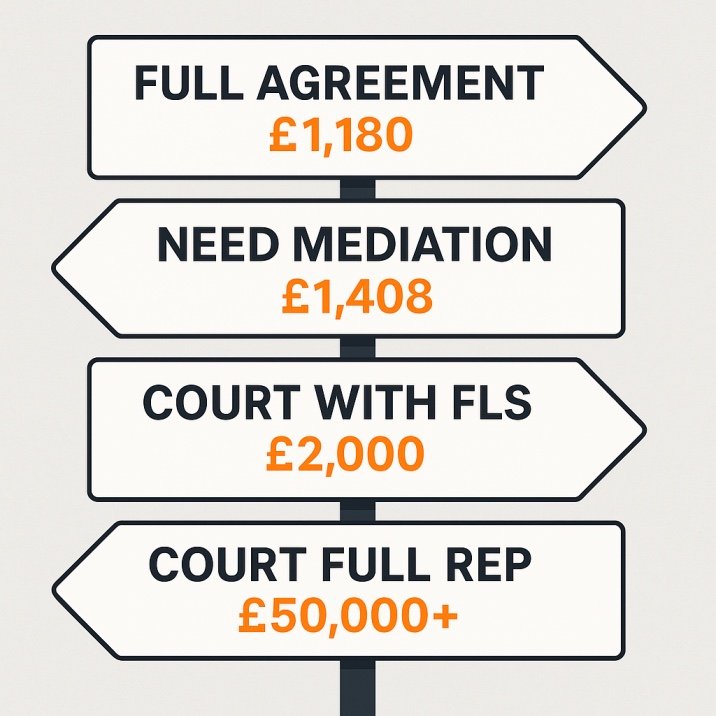
Let’s put actual numbers on this, because abstract warnings don’t help when you’re trying to budget.
Scenario 1: You Agree on Everything
What you’re agreeing:
- How to split the house (sell it, one buys the other out, or keep it until children are older)
- How to divide pensions and savings
- Child living arrangements and contact schedules
- No spousal maintenance, or the amount and duration
What it costs:
- Divorce application: £612 (you handle this yourself)
- FLS AI Barrister Review to check your agreement is fair: £9.50
- FLS Consent Order Drafting to make it legally binding: £499
- Court filing fee for consent order: £60
Total: £1,180.50
Scenario 2: You Mostly Agree, Need Mediation for Final Details
What you’re sorting:
- Generally aligned but stuck on house valuation, or pension split percentage, or whether maintenance should be paid
What it costs:
- Divorce application: £612 (or free if eligible)
- 4-6 mediation sessions: £400-£900 (or free with legal aid)
- FLS Consent Order Drafting: £499 (or free with legal aid)
- Court filing fee for consent order: £60 (or free if eligible)
Total: £1,571 to £2,071 (or £0 with legal aid / court fee redemption)
Scenario 3: You Can’t Agree on Finances, Going to Court
What’s happening:
- One of you thinks the house split should be 70/30, the other thinks 50/50
- Can’t agree on pension sharing or spousal maintenance
- Needs a judge to decide
What it costs with full legal representation:
- Divorce application: £612
- Cost of a MIAM: £150
- Form A application: £313
- Solicitor fees for financial proceedings: £25,000 to £50,000
- Barrister for final hearing: £2,500-£5,000
Total: £28,575 to £56,075
What it costs if you use FLS support instead:
- Divorce application: £612
- Form A application: £313
- FLS AI Barrister Review to understand likely outcome: £9.50
- FLS Form A completion help: £160
- FLS Form E completion help: £250
- FLS court preparation meeting & position statement: £425
- Represent yourself at hearings using FLS preparation
Total: £1,769.50
You’re still representing yourself, which is stressful. But you’re not walking in blind, and you haven’t spent nearly £30,000.
Scenario 4: You Can’t Agree on Child Arrangements, Going to Court
What’s happening:
- Disagreement over where children live primarily
- Can’t agree contact schedule (every other weekend? 50/50 shared care?)
- Disputes over school choice or medical decisions
What it costs with full legal representation:
- MIAM: £150
- C100 application: £232
- Solicitor fees for child arrangements proceedings: £15,000 to £25,000
- Multiple hearings over 6-12 months
Total: £15,382 to £25,382
What it costs if you use FLS support instead:
- MIAM: £150
- C100 application: £232
- FLS C100 form completion help and Cafcass Meeting prep: £350
- FLS court preparation meeting & position statement: £425
- Represent yourself using above FLS guidance
Total: £1,157
Want to get started? Just enter your name here. Click here
How to Reach Agreement (Even When You’re Angry With Each Other
The difference between a £1,200 divorce and a £40,000 divorce is agreement. So how do you get there when emotions are running high?
Start With the AI Barrister Review (£9.50)
Before you dig your heels in, understand what a court would actually order.
Our AI Barrister Review asks about your finances: income, property, pensions, children’s ages, earning capacity. It then generates a PDF report showing what a judge might decide based on current case law.
Why does this help?
Because most arguments happen in an information vacuum. He thinks he’s entitled to 70% because he paid more for the property. She thinks she deserves the whole house because she’s the primary carer. The AI report shows them both what’s realistic.
“We’ve had couples reach agreement within days of both seeing the AI Barrister Review,” Jess notes. “When you realise the court would probably order 60/40, suddenly a 55/45 agreement seems acceptable. Neither of you ‘win’, but you both avoid spending £50,000 finding out the court would have ordered something similar anyway.”
Try Mediation (Free with Legal Aid for Many People)

Mediation isn’t marriage counselling. You’re not reconciling. You’re negotiating a financial and practical divorce settlement with a neutral, trained professional keeping things on track.
A good family mediator:
- Helps you both understand what information is needed (property valuations, pension values, etc.)
- Explains legal principles without giving legal advice
- Keeps discussions focused on practical solutions, not past grievances
- Drafts a Memorandum of Understanding setting out what you’ve agreed
If you’re on benefits or low income, this is free. Even if you’re paying, 4-6 sessions typically cost £600-£1500 total. Compare that to a potential £50,000 in court costs.
Most people need 4-6 sessions to cover finances and children. You can agree some issues in mediation and take others to court if you’re genuinely stuck, narrowing the scope of the dispute. Most courts will expect you to have tried mediation before attending court and can allocate legal costs against you if you are unwilling to try.
Sometimes you genuinely can’t agree. Your ex is being unreasonable, hiding assets, or refusing to engage. In those situations, don’t pour years into failed mediation attempts.
But even when court is necessary, some people can’t always afford full legal representation. That’s the middle ground FLS provides.
Fixed-Fee Legal Services: Help Without the £25,000 Bill
Unlike traditional solicitors who charge £250-£400 per hour (and the bill increases every time you contact them), fixed-fee services tell you exactly what you’ll pay upfront.
At Family Law Service, we offer:
AI Barrister Review (£9.50)
Answer questions about your finances, income, children, and assets. Our AI-powered tool generates a detailed PDF report predicting what a court would likely order based on current family law principles.
it’s important to note, this isn’t legal advice, but it gives you a realistic benchmark. Most people use it before negotiating with their ex, or before deciding whether to accept a settlement offer.
Consent Order Drafting (£499 inc VAT)
If you’ve agreed finances with your ex, either directly or through mediation, we’ll draft the legal order the court needs to approve.
Compare this to solicitor fees of £750 to £5,000+ for the same work. We can draft it quickly because you’ve already done the hard part: reaching agreement.
Once drafted, you file it at court with the £60 consent order fee. The court reviews it, and if it’s fair, approves it. Your agreement is now legally binding.
Form Completion Support (£150-£300)
Stuck on the C100 application for child arrangements? Don’t understand what information you need for Form A? Not sure how to complete Form E showing your finances?
We guide you through it step-by-step. You’re still handling the application, but you’re not guessing what goes in each section.
Court Preparation Meetings (£200-£400)
If you’re representing yourself at a court hearing, preparation makes all the difference.
We’ll walk you through:
- What the judge will ask you
- How to present your case clearly
- What orders you should be requesting
- How to respond if your ex says something unexpected
- What documents to bring and how to reference them
We don’t attend court with you as that is either full representation, which costs £15,000-£50,000 or you can instruct a McKenzie friend local to you for support. Instead, we make sure you’re properly prepared, not walking in blind.
“We worked with a client facing a financial remedy hearing,” Jess recalls. “She couldn’t afford the £30,000 her solicitor quoted. We prepared her for £400 and an hour’s legal advice with a written report for £299. She represented herself, the judge found her clear and well-organised, and ordered a 55/45 split. Very close to what our AI Barrister Review had predicted. She spent under £1,000 in total, instead of £30,000+.”
When You Don’t Qualify for Legal Aid: Other Free Options
If you earn too much for legal aid but still can’t afford thousands in legal costs, these options exist:
Free Initial Consultations
Many solicitors offer 30 minutes free. Use this strategically:
Before your appointment, write down:
- Your specific questions (not “tell me about divorce” but “can he force me to sell the house immediately?”)
- Key financial details (property value, outstanding mortgage, pension values)
- What you want to achieve
Find family law solicitors offering free consultations through Resolution in England and Wales. Resolution members commit to reducing conflict, which often means lower costs overall. Please note most solicitors need to be instructed by you in order to give specific legal advice for your case. Though many will be able to give general advice and guidance during a free 30 minute session.
Law Centres and Free Advice Clinics
Law Centres offer free legal advice to local residents. Not all centres cover family law, but many do. Check the Law Centres Network to find your nearest branch.
LawWorks runs free legal advice clinics across England and Wales. Some specialise in family matters. Availability varies by area, but it’s worth searching their database.
Trade Union or Workplace Legal Services
Some trade unions include legal helplines for non-work issues. Coverage varies, but might include a free consultation with a family lawyer or access to a legal advice line.
If you’re a union member, check your benefits package. Many people forget they have this.
Pro Bono Legal Help
Some solicitors and barristers take cases pro bono (free) through:
- Law school clinics at local universities
- Pro bono referrals through LawWorks
- Individual firm pro bono programmes
These spots are limited and typically reserved for cases involving children’s welfare or domestic abuse, but it’s worth checking.
The DIY Divorce: What You Can Handle Yourself
You absolutely can divorce without a solicitor. Many people do.
The online divorce service on GOV.UK costs £612. You’ll need:
- Your marriage certificate
- Your ex’s current address
The application takes about 20 minutes. You submit it, your ex is notified, and assuming no objections, you’re divorced in 6-7 months.
What DIY divorce doesn’t include:
- Sorting out who gets the house
- Dividing pensions or savings
- Formalising child living arrangements
- Protecting yourself from future financial claims
You need these sorted separately. Ideally before the divorce finalises, definitely before you remarry or your ex remarries.
This is where people get unstuck. They handle the divorce itself, then realise they have no legal protection on finances.
The Consent Order: Why You Need One
Even if you trust your ex completely, even if you’ve agreed everything verbally, you should strongly consider a financial consent order.
Without it:
- Your ex can make a financial claim against you in future, even years later
- If either of you remarries, it’s too late to get a consent order
- Your agreement isn’t legally enforceable
“We see people five years after their divorce, now in new relationships, discovering their ex can still claim against them,” says Jess. “They trusted each other at the time, so didn’t bother with the £499 consent order. Now they’re facing potential claims against new property or pensions. That £499 would have protected them completely.”
A consent order provides a “clean break” which means neither of you can claim against the other in future.
Understanding Court Fees: What You’ll Actually Pay
Let’s be clear about government court fees, because confusion here can leads to expensive mistakes.
For the divorce itself: £612 to file online (or by post)
This covers ending your marriage legally. Most people handle this part themselves.
If you need the court to approve your financial agreement: £60 to file a consent order
This applies when you’ve already agreed how to split everything. You submit your agreement to the court, they check it’s fair, they approve it. They do not tell you what to do differently if they reject your consent order.
If you can’t agree finances and need the court to decide: £313 to file Form A
This starts financial remedy proceedings. You will usually need to have completed a MIAM (approx £150) unless an exemption applies. The court will eventually order how to split assets, but it typically takes 9-12 months and costs £25,000-£50,000 in legal fees, if you’re represented.
If you can’t agree child arrangements: £232 to file Form C100
This starts child arrangements proceedings. You will also usually need to have completed a MIAM (approx £150) unless an exemption applies. The court decides where children live and contact schedules. Typically costs £15,000-£25,000 in legal fees if represented, and takes 6-12 months. The government will currently give £500 in mediation voucher to try to help you reach an agreement outside of court. This is not means-tested.
In both the above situations, there maybe occasions when you need an urgent MIAM (with the signed court form immediately dispatched). You can book an urgent MIAM here.
Help With Court Fees
If you’re on certain benefits or have very low income and savings, you might not pay any of these fees.
Use the court fee help calculator on GOV.UK to check eligibility.
You’ll qualify if you receive:
- Income-based Jobseeker’s Allowance (JSA)
- Income-related Employment and Support Allowance (ESA)
- Income Support
- Universal Credit (and earn less than £6,000 per year)
- Pension Credit (Guarantee Credit)
Or if your income is below certain thresholds and you have less than £16,000 in savings.
Even if you’re working, you might qualify. Many people assume they won’t be eligible and never check.
Real Example: How Emma Reached Agreement for Under £600
Emma and her ex-husband owned a house worth £320,000 with £140,000 mortgage remaining. They had two children, ages 8 and 11. Emma earned £28,000 as a primary school teacher, her ex earned £42,000.
Her ex initially insisted on 50/50 split of everything. Emma thought she should get 70% because she’d be primary carer and earned less.
A high street solicitor quoted £3,500 to draft a consent order, more if they had to negotiate.
Instead, Emma:
- Used the FLS AI Barrister Review (£9.50) which suggested 60/40 split favouring Emma, with her keeping the house until the youngest child turned 18
- Showed the report to her ex
- They negotiated: Emma gets the house until youngest turns 18, then sells. She gets 58% of the equity at sale. He keeps his entire pension.
- FLS drafted their consent order (£499 inc VAT)
- Court approved it within four weeks (£60 filing fee)
Total cost: £568.50
Time from decision to divorce to final consent order: 8 weeks
Emma’s ex also saved thousands by not using a solicitor. Both felt the outcome was fair because they’d seen what a judge would likely take into account anyway.
“The AI report shifted the conversation from ‘what can I demand?’ to ‘what’s actually realistic?'” Emma told us. “We both compromised a bit from our opening positions, but we saved about £6,000 each in legal fees.”
If You Need to Go to Court: Representing Yourself With Support
Sometimes agreement isn’t possible. Your ex is hiding money, being deliberately obstructive, or you genuinely disagree on what’s fair for the children.
In those situations, court might be unavoidable.
Full legal representation costs:
- Finances: £25,000-£50,000 per person
- Child arrangements: £15,000-£25,000 per person
That’s not a typo. And both sides pay those costs, so a couple fighting over £200,000 in assets might spend £100,000 combined in legal fees, if they are both represented and the case goes to a final hearing.
The alternative: represent yourself with professional support
You’re still the one presenting your case to the judge. But you’re not alone.
FLS provides:
- Help completing forms correctly (£150-£300)
- AI Barrister Review so you understand realistic outcomes (£9.50)
- Court preparation meetings before each hearing (£200-£400)
- Review of your court bundle and witness statement (£300-£500)
You’ll spend £1,000-£2,000 total across the entire case, not £25,000.
What Representing Yourself Actually Involves
Let’s be honest: it’s stressful. The judge expects you to:
- Understand court procedures and deadlines
- Present your case clearly
- Provide evidence properly
- Understand legal principles like “needs, compensation, and sharing”
They won’t guide you through your case. They should treat you fairly, but they’re not your solicitor.
This is why preparation matters so much. An hour with FLS before your hearing means you understand:
- What orders to ask for
- How to respond to your ex’s claims
- What questions the judge will ask
- What evidence strengthens your position
People represent themselves successfully every day in family court. But the ones who do it well are the ones who prepare properly.
Frequently Asked Questions
Can I get legal aid if my ex was abusive years ago?
Possibly, yes. Legal aid for domestic abuse cases doesn’t require recent abuse. You need evidence from within the last five years, but that evidence can relate to abuse that happened further back. Accepted evidence includes police reports, court orders, medical records, or letters from social services or domestic abuse organisations. You can apply through a solicitor who offers legal aid, who’ll submit the application on your behalf.
What if I earn too much for legal aid but still can’t afford £25,000 for a solicitor?
This describes most people divorcing today. Fixed-fee services like ours specifically target this gap. You can also look into payment plans with some solicitors, though watch out for interest charges. Or represent yourself with professional support (our model), which brings costs down to £1,000-£2,000 for a full court case versus £25,000+ for legal representation.
Should I just do the divorce myself and save money?
Most people do handle the divorce application themselves, it costs £612 and is relatively straightforward paperwork on GOV.UK. But don’t confuse the divorce with sorting out finances and children. The divorce just ends your marriage legally. You still need to agree (or have court decide) financial splits and child arrangements, then formalise these legally. That’s where costs arise if you can’t agree.
How much does Family Law Service actually cost?
Our AI Barrister Review costs £9.50 and gives you a detailed PDF report on what a court would likely order based on your financial situation. Our Consent Order Drafting service costs £499 (inc VAT), compared to £720-£5,000+ that traditional solicitors charge. Form completion support ranges from £150-£300 depending on complexity. Court preparation meetings are £200-£400 per hearing. We’re transparent about pricing from the start, no hourly billing surprises.
Is mediation really cheaper than court?
Almost always, yes. Mediation typically costs £500-£100 total (or free with legal aid). Going to court for finances costs £25,000-£50,000 in legal fees if represented, or £1,000-£2,000 if you represent yourself with support. Going to court for child arrangements costs £15,000-£25,000 represented, or £600-£1,000 if you represent yourself with support. For child arrangements you get a £500 voucher towards your mediation costs.
Will the court help me if I represent myself?
The judge should ensure you get a fair hearing, but they won’t act as your solicitor. They can’t advise you on your case or tell you what orders to ask for. Court staff also can’t give legal advice. This is why FLS court preparation meetings make such a difference, you’re walking in knowing what to do, not hoping the judge will guide you.
What’s included in the AI Barrister Review?
You answer questions about your finances, income, property, pensions, children’s ages, and earning capacity. The AI analyses this against current family law principles and generates a PDF report showing what a court would likely order. It covers capital (house/savings) splits, potential spousal maintenance, and how long any payments might last. you can also ask it individual questions for your case. It’s not legal advice, but it’s based on established case law and the matrimonial causes act.
Can I use Family Law Service if we’re not divorcing yet?
Absolutely. Many clients come to us before starting the divorce. We can provide the AI Barrister Review to help you negotiate a separation agreement. Getting realistic expectations early often prevents expensive court battles later. Some couples use the AI report as a basis for their mediation discussions.
What if my ex won’t engage with mediation or negotiation?
Then court may become necessary, unfortunately. But even then, you don’t have to spend £25,000 on full representation. Our court preparation services help you represent yourself effectively. We can’t attend hearings with you, but we ensure you understand procedures, know what to say, and present your case clearly. Judges see self-represented litigants every day, preparation is what matters. Also consider other methods of dispute resolution such as using an arbitrator.
Making Your Decision: What Should You Do Next?
Start by honestly assessing where you are with your ex:
If you’ve already agreed everything:
- Handle the divorce yourself (£612)
- Get the AI Barrister Review to confirm your financial agreement is fair (£9.50)
- Use FLS to draft your consent order (£499)
- File it at court (£60)
- Total cost: £1,180.50
If you’re close to agreement but stuck on a few details:
- Try mediation (free with legal aid, or £400-£900)
- Use the AI Barrister Review as a reality check (£9.50)
- Turn your mediated financial settlement into a consent order with FLS (£499)
- Total cost: £908.50 to £1,408.50 (or £508.50 with free mediation)
If you’re far apart and communication is difficult:
- Get the AI Barrister Review to understand realistic outcomes (£9.50)
- Try mediation with your barrister report as a starting point
- If mediation fails, prepare for court with FLS support (£1,000-£2,000 total)
- Avoids full legal representation
If you’re experiencing domestic abuse:
- Apply for legal aid through a solicitor, you can get full representation
- Don’t need to attempt DIY or mediation in these circumstances
- The government should pay for your legal costs
“The biggest mistake we see is people thinking they have to choose between paying £25,000 or doing everything completely alone,” Jess notes. “There’s a whole range of options in between now. The key is matching your specific situation to the right level of support. And above all, finding ways to reach agreement, because that’s what makes divorce affordable.”
Find Out What You’re Really Entitled To
Our AI Barrister Review shows what a court would likely order – for just £9.50
✓ Instant access | ✓ PDF report in minutes | ✓ Based on real case law