



Updated 15 December 2025 | Fact Checked By Jess Knauf, Co-Founder, Family Law Service
Summary
- Family law and mediation work together to help separating couples resolve disputes about children, finances, and property without expensive court battles
- Family law covers divorce, financial settlements, child arrangements, and spousal maintenance in England and Wales
- Mediation is a voluntary process where a trained mediator helps couples reach their own agreements, costing £400-£1,000 total (or free with legal aid)
- Court proceedings cost £15,000-£50,000 per person in legal fees, making mediation the more affordable option for most couples
- You must attend a MIAM (Mediation Information and Assessment Meeting) before applying to court, unless an exemption applies
- FLS AI Barrister Review (£9.50) helps you understand realistic outcomes before mediation, increasing your chances of reaching agreement
- Even if mediation succeeds, you need legal documents like consent orders (£499 at FLS) to make your agreement legally binding
Family law and mediation are two terms you’ll hear constantly when you’re separating or divorcing, but most people don’t understand how they fit together or when to use each one.
Here’s the simple truth: family law is the legal framework that governs separation and divorce. Mediation is one way of resolving family law issues without going to court.
Think of family law as the rules of the game. Mediation is one way to play it, negotiation is another, and court is the expensive, stressful version you want to avoid if possible.
This guide explains both, how they work together, when mediation makes sense, and when you need something else. Most importantly, it shows you how to get affordable help with both.
What Is Family Law?
Family law covers the legal side of relationships breaking down. In England and Wales, it includes:
- Divorce or dissolution – legally ending your marriage or civil partnership
- Financial settlements – dividing property, pensions, savings, and debts
- Child arrangements – where children live and how much time they spend with each parent
- Spousal maintenance – ongoing financial support from one ex-partner to another
- Child maintenance – financial support for children
- Domestic abuse protection – non-molestation orders and occupation orders
When you separate, family law provides the legal structure for sorting all of this out. But “sorting it out” can happen in different ways.
You can:
- Agree directly with your ex and formalise it legally (cheapest option)
- Use mediation to help you reach agreement (middle option)
- Go to court and let a judge decide (most expensive option)
Most people assume they need solicitors and court proceedings. They don’t. Around 80% of separating couples can resolve things through agreement or mediation, saving tens of thousands in legal costs.
What Is Mediation?
Mediation is a process where a trained, neutral professional (a mediator) helps you and your ex reach your own agreements about finances, property, and children.
What mediation is:
- A structured conversation with a neutral third party present
- Voluntary (both of you have to agree to try it)
- Confidential (what’s discussed stays private)
- Focused on practical solutions, not past grievances
What mediation isn’t:
- Marriage counselling or relationship therapy
- Legal advice (mediators don’t advise you what to do)
- Free-for-all arguing (mediators keep things constructive)
- Legally binding on its own (you need a consent order afterwards)
Mediation sessions typically last 60-90 minutes. Most couples need 4-6 sessions to cover finances and children, though simpler cases might only need 2-3.
“At Family Law Service, we often see clients who think mediation means getting back together or compromising on things that matter to them,” says Jess Knauf, Co-Founder. “But mediation is about finding practical solutions that work for both of you and your children. It’s not about winners and losers.”
How Family Law and Mediation Work Together
Here’s where people get confused: you can use mediation to resolve family law issues, but mediation alone doesn’t make anything legally binding.
Let’s say you use mediation to agree:
- You’ll keep the family home until your youngest child turns 18, then sell it 60/40 split
- Children will live primarily with you, spending alternate weekends with your ex
- No spousal maintenance will be paid
That’s brilliant progress. But without the right legal documents, those agreements aren’t enforceable.
You need:
- A financial consent order to make the financial agreement legally binding (£499 at FLS, or £720-£5,000 with traditional solicitors)
- A child arrangements order (if you want court approval) or a written parenting plan
This is where family law services like FLS come in. We don’t provide mediation, but we help you turn your mediated agreements into proper legal documents that protect you both.
The MIAM: Your First Step Before Court
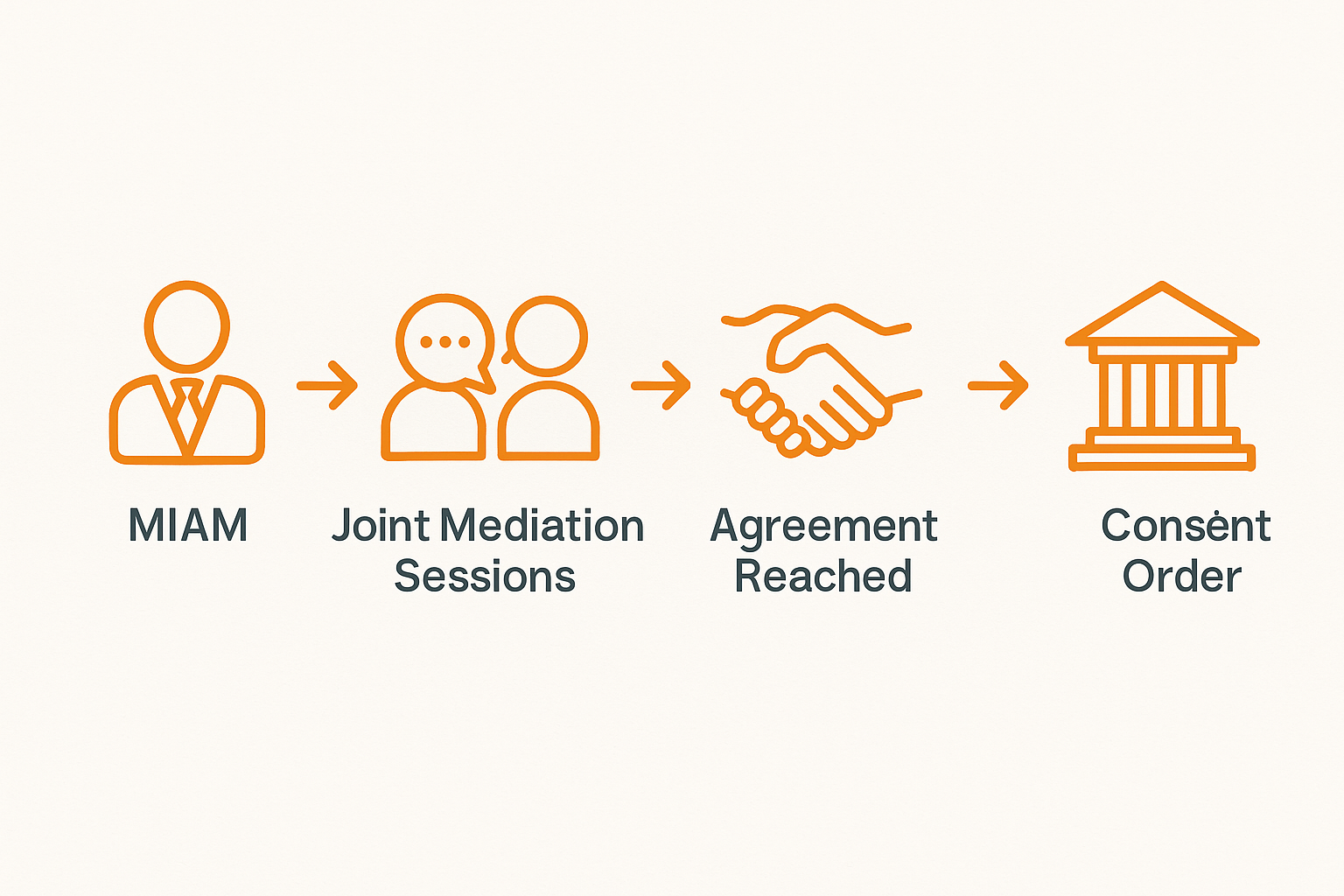
If you’re considering applying to court for finances or child arrangements, you must attend a MIAM first (unless an exemption applies).
MIAM stands for: Mediation Information and Assessment Meeting
It’s a solo meeting (your ex attends separately) where a mediator:
- Explains how mediation works
- Assesses whether it’s suitable for your situation
- Discusses costs and legal aid eligibility
- Issues a certificate if mediation isn’t appropriate
Cost: Around £150 per person
Duration: 45-60 minutes
Exemptions from attending a MIAM:
- Domestic abuse (with evidence)
- Urgency (e.g., risk to child welfare)
- Your ex is in prison or outside England and Wales
- Previous MIAM within the last 4 months
- Child protection proceedings are active
If the mediator thinks mediation could work, your ex will be invited to attend. If both agree, you’ll book joint sessions.
If either of you decides not to proceed, the mediator issues a certificate allowing you to apply to court. Courts take this seriously – if you’ve unreasonably refused mediation, you might face costs penalties later.
Book a MIAM through accredited mediators on the Family Mediation Council website. If you need an urgent MIAM (with the signed court form dispatched immediately), Mediate UK offers this service.
When Mediation Works Best
Mediation succeeds when:
You can still communicate (even if it’s difficult) You don’t have to be friendly, but you need to be able to sit in the same room or video call and exchange information civilly.
You both want to avoid court If one of you sees court as a way to “punish” the other, mediation struggles. Both need to genuinely want an agreement.
You’re willing to compromise Nobody gets 100% of what they want in mediation. The goal is fair solutions both can live with.
You can disclose finances honestly Mediation requires full financial disclosure. If one of you is hiding assets or income, it won’t work.
There’s no domestic abuse If there’s been abuse (including financial control), mediation is usually inappropriate. Legal aid might be available for solicitor representation instead.
Real example:
Sarah and Tom had been married 12 years with two children. Sarah earned £32,000 as a teacher, Tom earned £48,000 in sales. Their house was worth £280,000 with £120,000 mortgage remaining.
They couldn’t agree on the house split. Sarah wanted 70% because she’d be primary carer. Tom wanted 50/50 because he’d contributed more to the deposit.
Rather than spend £50,000 combined in court costs, they:
- Used the FLS AI Barrister Review (£9.50 each) to see what a court would likely order
- The report suggested 60/40 split favouring Sarah, house retained until youngest turns 18
- Armed with realistic expectations, they attended mediation (£750 total for 5 sessions)
- Agreed 58/42 split, house retained until youngest turns 16 instead of 18
- FLS drafted their consent order for £499
Total cost: £1,258.50 combined, agreement reached in 6 weeks
Compare that to £50,000+ combined in court costs over 12 months.
Want to get started? Just enter your name here. Click here
When Mediation Won’t Work
Don’t force mediation if:
Domestic abuse is present This includes physical violence, coercive control, financial abuse, or emotional abuse. If you’re scared of your ex, mediation isn’t appropriate.
Apply for legal aid for solicitor representation instead. You’ll need evidence of abuse from the last 5 years.
Your ex won’t disclose finances Mediation requires both parties to share full financial information. If your ex is hiding assets, running a business “off the books”, or refusing to provide payslips and bank statements, mediation can’t work.
In these cases, court has powers to force disclosure that mediators don’t have.
Mental health or addiction issues prevent engagement If your ex (or you) are dealing with severe mental health issues or active addiction that prevents rational discussion, mediation should wait.
There’s a huge power imbalance If one of you dominated the relationship and the other struggles to advocate for themselves, mediation can reinforce that imbalance.
Geography makes it impossible If one of you has moved abroad or to a remote part of the UK, practical mediation becomes difficult (though some mediators offer online sessions).
In these situations, you’ll need court proceedings. FLS can still help by:
- Completing your court forms (C100 or Form A) – £150-£350
- Preparing you for hearings – £200-£425
- Providing one-hour legal advice (£299) to understand your position
- Drafting position statements and court bundles
“We worked with a client whose ex refused to attend mediation and was hiding income from a side business,” Jess recalls. “She couldn’t afford the £35,000 her solicitor quoted for court representation. We helped her complete Form A (£160), prepared her for the First Appointment (£425), and reviewed her financial disclosure. She represented herself with our support and the judge ordered full disclosure from her ex. Total cost: under £1,000 versus £35,000 for full representation.”
What Gets Discussed in Mediation?
Mediation typically covers three main areas:
1. Financial Arrangements
Property:
- Who keeps the family home?
- If you sell it, how do you split proceeds?
- What about other properties (buy-to-lets, holiday homes)?
Pensions:
- Should pensions be shared via a pension sharing order?
- Or offset against other assets (e.g., one keeps the house, one keeps the pension)?
Savings and investments:
- How to divide bank accounts, ISAs, shares, premium bonds
Debts:
- Who’s responsible for joint credit cards, loans, or overdrafts?
Spousal maintenance:
- Should one of you pay the other ongoing support?
- How much and for how long?
The mediator will ask both of you to complete Form E (financial disclosure form) so everyone knows what assets and income exist. This is the same form used in court proceedings.
2. Child Arrangements
Living arrangements:
- Where will children live primarily?
- Will it be shared care (50/50) or one primary home?
Contact schedule:
- How often will children see the non-resident parent?
- Weekends, midweek, school holidays?
Parental responsibility:
- Who makes decisions about education, medical treatment, religion?
- How will you communicate about the children?
Practicalities:
- Who pays for what (clothes, activities, school trips)?
- How will handovers work?
- What about introducing new partners?
Child maintenance:
- Will you use the CMS (Child Maintenance Service) calculation?
- Or agree a private arrangement?
3. Other Issues
- Pets (who keeps the dog?)
- Wedding rings and sentimental items
- Season tickets or memberships
- How to handle joint friends and family
The mediator keeps discussions focused on practical solutions. If emotions run high, they’ll call a break. If you’re stuck on one issue, they might suggest parking it and returning later.
How Much Does Mediation Cost?
Mediation costs vary by provider and region, but typical costs are:
MIAM (initial assessment): £150 per person Joint mediation sessions: £120-£150 per person per session Total for 4-6 sessions: £600-£1,200 combined
Legal aid for mediation:
If you’re on a low income or benefits, mediation might be free. Legal aid covers:
- Your MIAM
- All mediation sessions until you reach agreement
- Your ex’s MIAM and first joint session (even if they don’t qualify)
- Turning your agreement into a legally binding document
Check eligibility at GOV.UK. You’ll typically qualify if you receive income-based benefits or earn less than around £2,657 per month before tax.
Government voucher scheme:
There’s a £500 voucher towards mediation for child arrangements. This isn’t means-tested – anyone can apply. Find out more at GOV.UK voucher scheme.
Compare to court costs:
Court proceedings with solicitor representation:
- Financial remedy: £25,000-£50,000 per person
- Child arrangements: £15,000-£25,000 per person
Even if you represent yourself with FLS support, court still costs £1,000-£2,000 total. Mediation at £1,000 combined is far cheaper and faster (weeks vs. 12+ months).
After Mediation: Making It Legal
Let’s say mediation succeeds. You’ve agreed how to split everything, where the children will live, and whether maintenance will be paid.
You’ll receive a Memorandum of Understanding from your mediator. This document summarises everything you’ve agreed.
Critical point: This document is NOT legally binding.
Your ex could change their mind tomorrow, and you’d have no legal recourse. To protect yourself, you need:
For Financial Agreements: A Consent Order
A consent order turns your financial agreement into a court order. Once approved by a judge, it’s legally enforceable. Neither of you can make future financial claims against the other (called a “clean break”).
What it covers:
- Property division
- Pension sharing
- Lump sum payments
- Spousal maintenance (or agreement there won’t be any)
- Declaration that neither can claim against the other in future
Cost at FLS: £499 (inc VAT) Cost at traditional solicitors: £720-£5,000+ depending on complexity
Court filing fee: £62
The process:
- We draft the consent order based on your Memorandum of Understanding
- You and your ex both sign it
- You file it at court with Form A (if not already filed) or D81 (if you’re already divorced)
- A judge reviews it
- If it’s fair, they approve it (usually 4-6 weeks)
- You both receive a sealed copy – this is now a court order
If the judge thinks it’s unfair (e.g., one of you is getting a terrible deal), they might reject it and ask for amendments. This is rare if you’ve used mediation and both had independent legal advice.
For Child Arrangements: Written Agreement or Court Order
Most couples don’t need a court order for children. A written parenting plan signed by both of you is usually enough.
However, you might want a Child Arrangements Order if:
- You think your ex might not stick to the agreement
- You need something official for schools, doctors, or passport applications
- One of you wants to move away with the children
- There are safeguarding concerns
To get a court order by consent:
- File Form C100 (£232 court fee, or free if eligible)
- Attach your mediated agreement
- The court will usually approve it without a hearing
FLS can help complete the C100 form for £160, or provide the full C100 and CAFCASS prep package for £350.
Using FLS Alongside Mediation
Family Law Service doesn’t provide mediation, but we support you before, during, and after the mediation process.
Before Mediation: AI Barrister Review (£9.50)
Going into mediation without knowing what’s realistic is risky. You might push for something the law doesn’t support, wasting time and money.
Our AI Barrister Review asks about your finances, income, children, and circumstances. It generates a PDF report showing what a court would likely order based on current family law principles.
How this helps mediation:
- You know what’s realistic before discussions start
- You can identify where you’re willing to compromise
- You can spot if your ex is being unreasonable
- Both of you can use it as a neutral starting point
“We’ve seen couples reach agreement in their first mediation session after both reading the AI Barrister Review,” says Jess. “When you both see what a judge would probably order anyway, suddenly a negotiated settlement makes sense. You save months of arguing and tens of thousands in legal fees.”
During Mediation: Legal Advice (£299 for 1 hour)
Mediators can’t give you legal advice. They explain legal principles but won’t tell you whether a specific agreement is in your interests.
At tricky points in mediation (e.g., should you accept 55% of the house equity?), it can help to pause and get proper legal advice from a qualified solicitor.
FLS offers one-hour advice sessions (£299) where you can:
- Explain what’s been discussed in mediation
- Ask whether the proposal is fair
- Understand the legal implications
- Get guidance on what to push back on
You then return to mediation better informed.
After Mediation: Consent Order Drafting (£499)
Once you’ve reached agreement, we draft your consent order quickly and accurately.
Most couples have their approved court order within 6-8 weeks of agreeing in mediation.
This is the important final step that makes everything legally binding and protects both of you from future claims.
Alternative Dispute Resolution: Beyond Mediation
Mediation is the most common form of Alternative Dispute Resolution (ADR), but it’s not the only option.
Collaborative Law
Both of you hire specially trained collaborative lawyers who commit to settlement without court. You all meet together (couple plus both lawyers) to negotiate.
If negotiations fail, both lawyers must withdraw – they can’t represent you in court. This creates strong incentive to settle.
Cost: £5,000-£15,000 per person Best for: Couples with complex finances who can communicate but want legal representation in negotiations
Arbitration
You hire a private judge (usually a retired family court judge or senior barrister) to make a binding decision about your dispute.
Faster than court, more private, and you choose the arbitrator. But you still pay for legal representation and the arbitrator’s fees.
Cost: £10,000-£30,000+ combined Best for: Complex financial cases where you need a quick decision and can afford the cost
Solicitor Negotiation
Your solicitors negotiate via letters and emails without court proceedings. This is what most people think of as “hiring a solicitor”.
It can work well, but it can also drag on expensively if neither side is willing to compromise.
Cost: £5,000-£15,000+ per person Best for: Cases needing legal input but where direct negotiation between parties won’t work
For most people, mediation offers the best balance of cost, speed, and fairness.
Common Myths About Mediation
Myth 1: “Mediation is only for amicable couples”
Wrong. Mediation works even if you can’t stand each other, as long as you can be civil for 90 minutes with a professional present. Mediators are trained to manage conflict.
Myth 2: “Mediation means I’ll lose out”
Mediation isn’t about splitting everything 50/50. It’s about reaching a fair agreement based on family law principles. That might mean 60/40 or 70/30 depending on your circumstances.
Myth 3: “I need a solicitor at mediation”
No. Mediation is designed for you to attend without lawyers. However, getting independent legal advice between sessions can be valuable.
Myth 4: “Whatever we agree in mediation is final”
Not quite. You can withdraw from mediation at any time before signing the consent order. And you should never sign something you don’t understand or that feels unfair.
Myth 5: “Mediation is just couples therapy”
Absolutely not. Mediators don’t care about your relationship or who did what. They focus purely on practical, legal, and financial arrangements going forward.
Myth 6: “The mediator will tell us what to do”
Mediators are neutral. They facilitate discussion but don’t impose solutions. If you can’t agree, you can’t agree – and you’ll need court instead.
Frequently Asked Questions
Can I go to mediation without a solicitor?
Yes, and this is how mediation normally works. You don’t need solicitors present at mediation sessions. However, it’s sensible to get independent legal advice before signing any final agreements. FLS offers one-hour advice sessions for £299, or you can use our AI Barrister Review (£9.50) to understand likely outcomes before mediation starts.
What happens if we can’t agree in mediation?
The mediator will issue you a certificate confirming mediation was attempted. You can then apply to court for a judge to decide. Your mediation discussions remain confidential and can’t be used in court proceedings. The time and money spent on mediation isn’t wasted – it often clarifies the issues and narrows the scope of what the court needs to decide.
Do we attend mediation together or separately?
After the initial MIAM (which you attend separately), most mediation sessions are joint – you’re both in the room (or on the same video call) with the mediator. Some mediators offer “shuttle mediation” where you’re in separate rooms and the mediator moves between you. This can work if there’s been domestic abuse but mediation is still appropriate with safeguards.
How long does mediation take from start to finish?
Most couples reach agreement within 4-6 sessions over 2-3 months. Complex cases involving multiple properties or businesses might take longer. Simple cases (e.g., no property, just sorting child arrangements) might only need 2-3 sessions. Once you’ve agreed, getting the consent order approved by court takes another 4-6 weeks.
Will mediation work if my ex is being unreasonable?
Maybe. Mediators are skilled at managing unreasonable behaviour and helping people see reality. Using tools like the FLS AI Barrister Review (£9.50) can help by showing both of you what a court would likely order. If your ex sees they won’t get the 80% they’re demanding, they often become more reasonable. If they remain truly unreasonable despite the mediator’s efforts, mediation will fail and you’ll need court.
Can I bring a friend or family member to mediation?
Usually no. Mediation is designed for just the two of you and the mediator (and sometimes a co-mediator). However, if you have a learning disability, language barrier, or other reason why you need support, mediators can make accommodations. Some mediators allow supporters in separate rooms (available for consultation but not in the session).
What if we agree on children but not finances (or vice versa)?
Mediation can be “issues-based” – you only mediate the things you can’t agree on. If you’ve already sorted child arrangements between yourselves, mediation can focus purely on finances. Or if you need court for a complex financial dispute but can agree on children through mediation, that’s fine too. You don’t have to mediate everything or nothing.
Do I have to pay for my ex’s mediation?
No. Each person pays their own mediation costs unless you specifically agree otherwise. However, if you qualify for legal aid, it will cover your ex’s MIAM and first joint session even if they don’t qualify themselves. This is to remove financial barriers to trying mediation.
Making Your Decision: Mediation, Court, or Direct Agreement?
Here’s a simple decision tree:
If you’ve already agreed everything:
- Skip mediation entirely
- Use FLS AI Barrister Review (£9.50) to check it’s fair
- Get your consent order drafted (£499)
- Total cost: ~£570
If you’re close to agreement but stuck on a few details:
- Attend mediation (£600-£1,000 combined, or free with legal aid)
- Get FLS to turn your agreement into a consent order (£499)
- Total cost: £1,100-£1,500
If you’re far apart and need help reaching agreement:
- Both complete FLS AI Barrister Review (£9.50 each = £19)
- Attend mediation armed with realistic expectations (£600-£1,000)
- Consider one-hour legal advice mid-mediation if needed (£299)
- Get consent order drafted after agreement (£499)
- Total cost: £1,420-£1,820
If mediation won’t work (domestic abuse, hidden assets, complete refusal to engage):
- Apply to court for financial remedy or child arrangements
- Use FLS for form completion (£160-£350), court preparation (£425), and ongoing support
- Represent yourself with professional backup
- Total cost: £1,000-£2,000 vs £25,000-£50,000 for full representation
“The key is honesty about whether you can work with your ex or not,” says Jess. “Forcing mediation when it’s clearly not appropriate wastes time and money. But avoiding it when it would work because you’re angry costs you tens of thousands. Our AI Barrister Review helps because it shows you what you’d likely get in court anyway – which makes mediation feel less like ‘giving in’ and more like ‘getting a sensible result faster’.”
Find Out What You’re Really Entitled To
Our AI Barrister Review shows what a court would likely order – for just £9.50
✓ Instant access | ✓ PDF report in minutes | ✓ Based on real case law